Covered
Checks subcontractor insurance certificates and proves every answer with a quote.
Nov 2026 · Solo: spec, architecture, build
Covered reads certificates of insurance, checks each one against a builder's rules file, and marks it pass, fail, expiring or needs review. An AI only reads the certificate. Plain code does every check, and every value has to be proven by a word-for-word quote from the PDF before it can count.
- quotes re-verified in the synthetic sample
- 436/436
- statuses match my own answer key
- 10/10
- tests passing (non-browser)
- 2,584
- statuses, with needs review as the safe default
- 4
The problem
A builder or general contractor has to collect a certificate of insurance from every subcontractor and check it by hand. The right policies, limits at or above the minimum, policies in force on the right date, the builder named as additional insured and as certificate holder, and the required wording in the description.
It is slow, repetitive work, and one missed detail can leave the builder exposed. An AI that "just reads it and says yes" is not good enough here. If it is wrong, nobody can tell why.
So I wanted a checker where every result comes with a reason and the exact line on the certificate that backs it up.
Who it's for
Office or compliance staff at builders and general contractors who collect certificates from subcontractors. The rules file is written for someone who does not code.
What it does
- Reads the text of each certificate PDF and refuses scanned, encrypted or textless files instead of guessing.
- Uses an optional AI reader to pull out the insured, holder, insurers and every policy row, each with a page number and a verbatim quote.
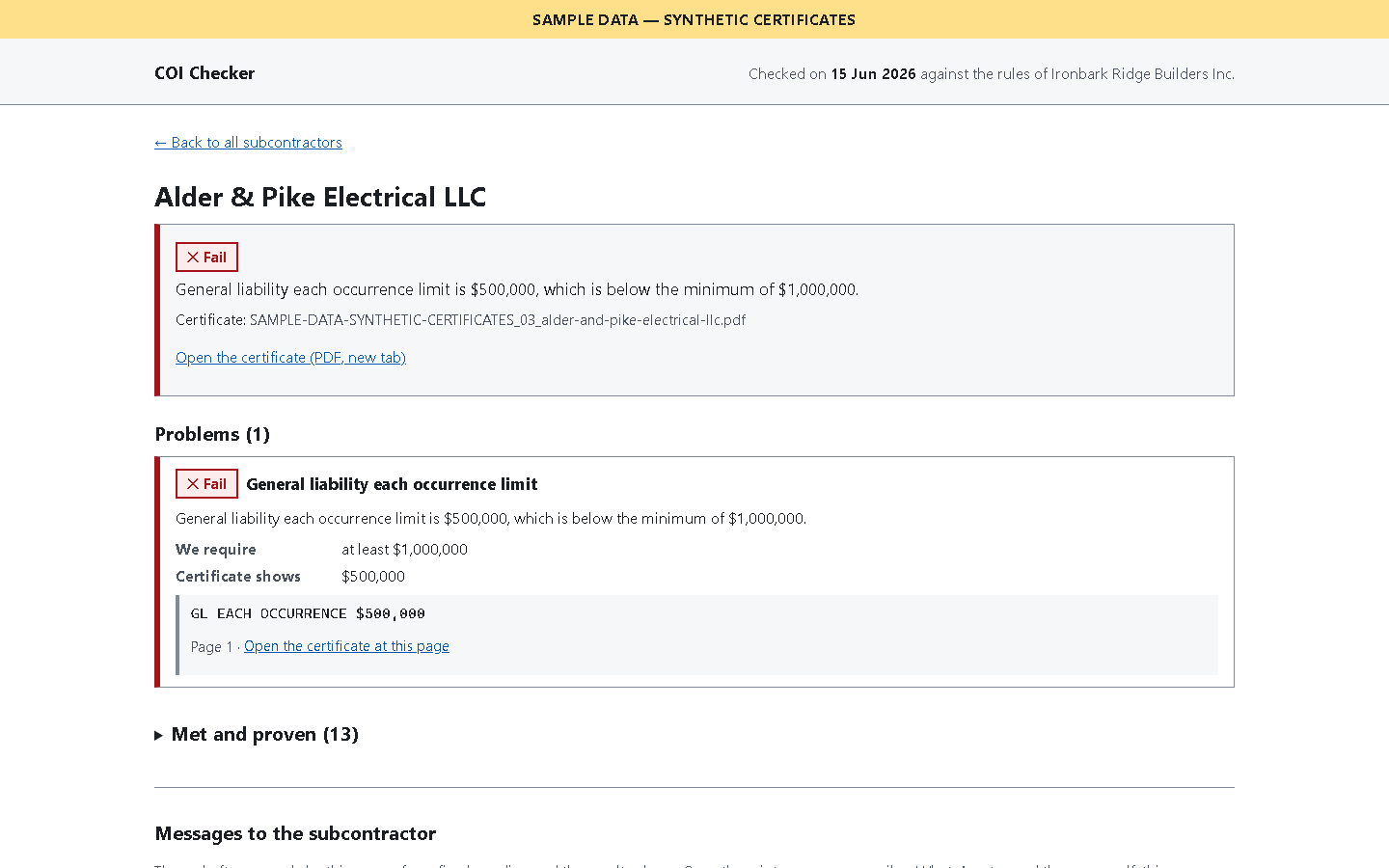
- Re-proves every quote against the PDF text on every run. A value that cannot be proven can only lead to needs review.
- Checks the builder's plain-text rules: required policies, minimum limits, in force on the check date, expiring soon, additional insured, certificate holder and required phrases.
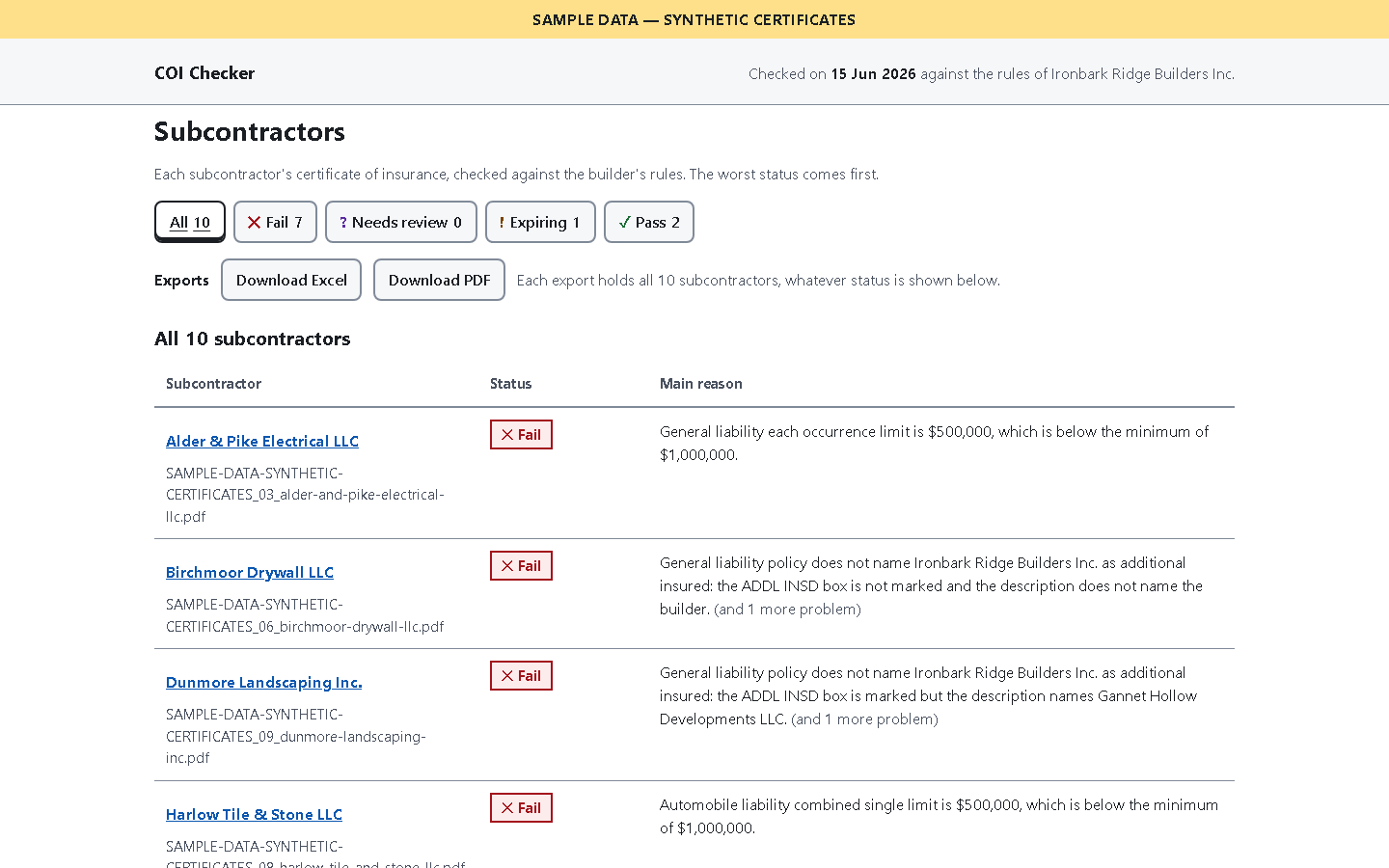
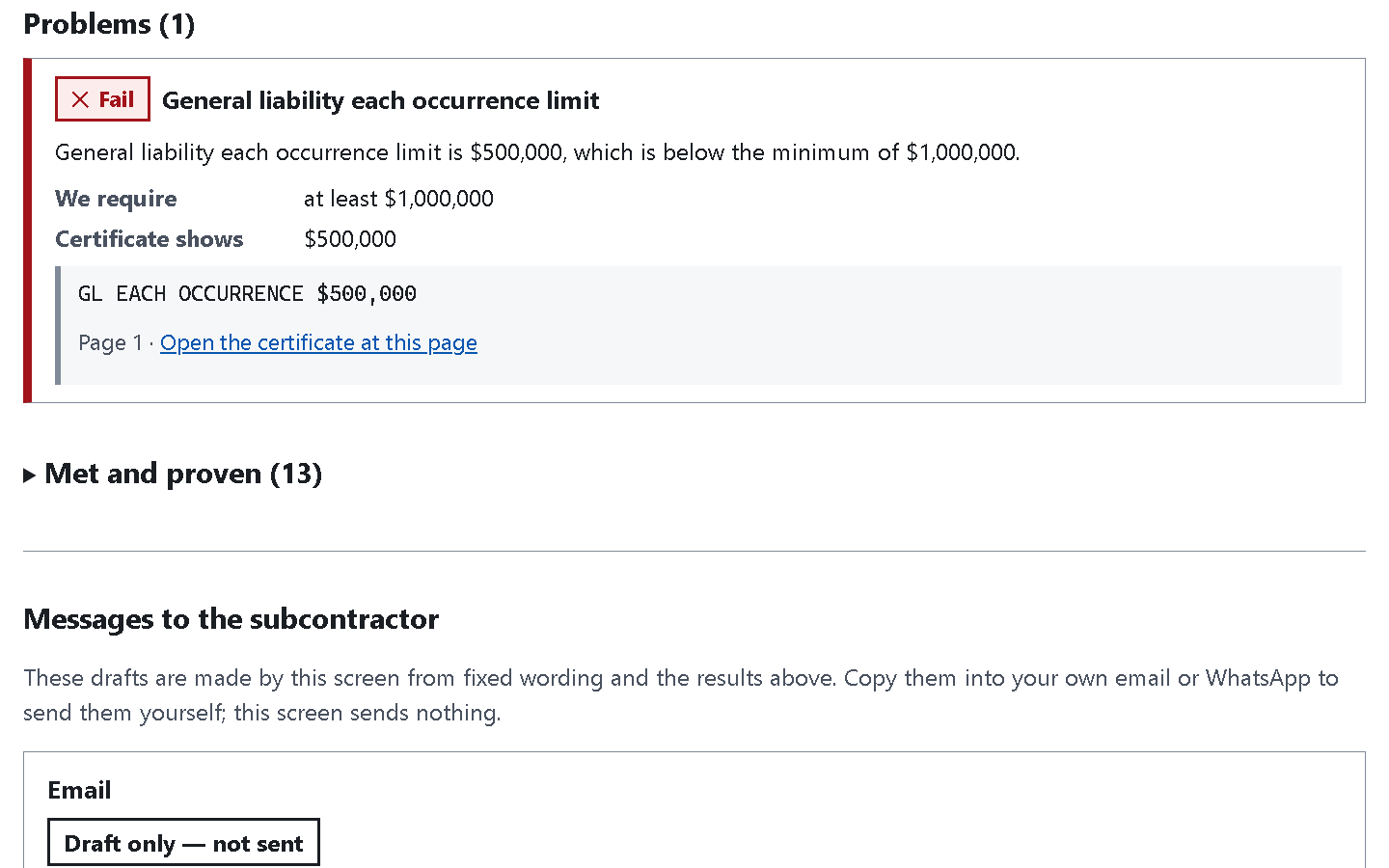
- Shows results worst first on a local review screen, with the reason, the quote and a link to the PDF page.
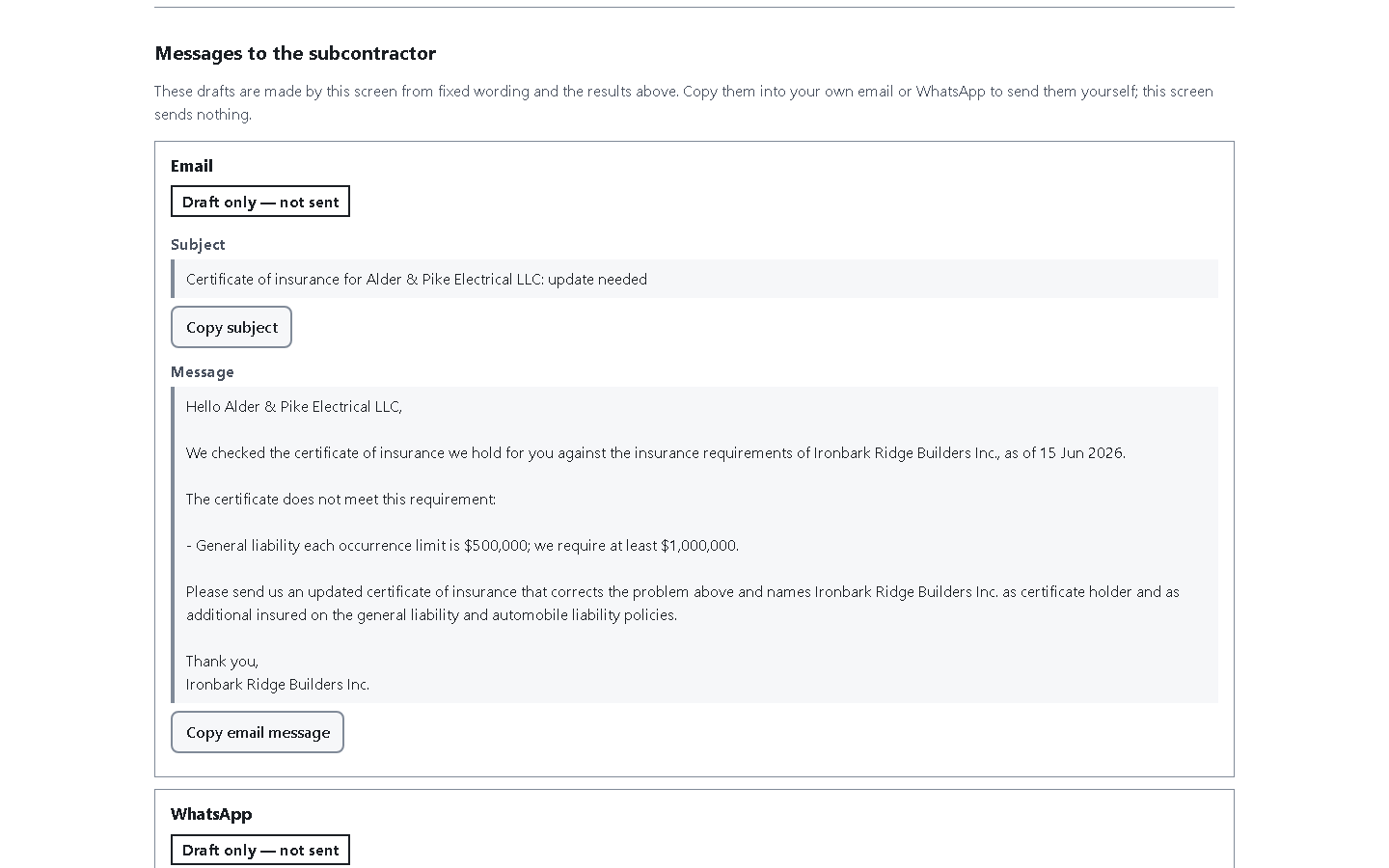
- Writes email and WhatsApp follow-up drafts from fixed templates. They are copy-only and never sent.
- Exports an Excel workbook and a PDF summary.
How it works
Read the PDF
pypdf pulls the page text. No OCR, so unreadable files are refused.
AI extracts
An LLM returns structured fields, each with a page and a verbatim quote. It never sees the rules.
Prove each value
Code checks each quote is on that page, after its own label, on its own row.
Apply the rules
Plain code checks the builder's TOML rules against a check date passed in.
Pick a status
Worst result wins: fail, then needs review, then expiring, then pass.
Person reviews
Review screen, follow-up drafts to copy, Excel and PDF exports. Nothing is sent.
Key engineering decisions
The AI reads. It never judges.
The model is used only as a structured extractor. It is never told the builder's requirements or the date, and never asked whether anything passes. All pass and fail decisions are deterministic code that I can test line by line.
No quote, no verdict
Every value must carry a verbatim quote and a page number. The checker re-proves each quote against the PDF text on every run, anchored to the value's own label and row. It ignores any "verified" flag from the AI or a saved file. An unproven value can only produce needs review, and tests cover tampered readings.
Treat certificate text as data, not instructions
The page text goes to the model inside fence lines that carry a hash of the text, so the certificate cannot close the fence early. A test fixture with an injected instruction line checks this. The Claude Code CLI backend runs with no tools, no MCP servers and no saved session.
Guard what leaves the machine
Only PDFs marked as sample data can be sent to an AI, because free tiers may keep what they receive. The guard builds the outbound messages itself and allows at most 3 requests per certificate. After 3 invalid answers the certificate is marked unreadable, not guessed.
Built-in eval harness
A generator makes synthetic certificates with planted problems, decoys and an answer key. One demo command runs the whole pipeline offline and exits with an error if any status, reason or quote differs. Readings are pinned to the PDF's SHA-256 and the instructions version, so results are reproducible.
Screens
Honest limits & what's next
Limits today
- Only the synthetic sample layout is recognised. Real ACORD 25 forms currently come out as needs review for every requirement.
- The accuracy numbers are measured against my own generated answer key, not against real-world certificates.
- Real certificates cannot be AI-read in this version. The sample-only guard refuses them.
- No OCR, so scanned or image-only PDFs are refused.
- It checks what the certificate says, not the underlying policy, and it does not confirm the insurer is real. It runs locally only.
Next
- Support real ACORD 25 layouts, tested on certificates shared with permission.
- Add OCR for scanned certificates, with the same quote-proof rule.
- Allow real certificates to be read with a provider that does not keep data.
Built with
- Python 3.13
- pypdf
- PydanticAI
- Pydantic v2
- Claude Code CLI
- Gemini 2.5 Flash
- FastAPI
- Jinja2
- TOML
- openpyxl
- reportlab
- pytest + Playwright
All certificates, subcontractors, insurers and the builder are synthetic, generated by the project itself. The code is private. A code walkthrough is available on request: get in touch.