BookedSolid
The setup, guardrails and ROI layer around GoHighLevel AI for home-service contractors.
Nov 2026 · Solo: spec, architecture and review. Code written by a Claude Code agent team I directed
BookedSolid is the companion app for a lead-to-job service for small US contractors. GoHighLevel's own Conversation AI and Voice AI answer the leads; BookedSolid sets up each client's account safely, compiles their answers into prompts with fixed guardrails, and shows the owner what their leads turned into. It is code complete and tested against mocks, but not deployed yet.
- guardrail rules checked on compiled prompts
- 13
- user stories built, reviewed and QA-checked
- 45
- SQL migrations, row-level security on client tables
- 12
- Vitest + Playwright tests passing, per the build report
- 1,875 + 71
The problem
Small contractors pay for leads from ads, Google and marketplaces like Angi, HomeAdvisor and Thumbtack. Then the leads stall. The owner misses the call because he is on a roof, nobody books the visit, and quotes are never chased.
GoHighLevel can answer, book and follow up. But setting it up by hand for each client is slow and easy to get wrong, the AI prompts drift from client to client, marketplace leads arrive as emails it does not read, and the owner has no clear proof the money is coming back.
BookedSolid fills those gaps. It does not replace the AI inside GoHighLevel. It makes that AI safer and more consistent to run for many clients at once.
Who it's for
Owner-operated home-service businesses (roofing, HVAC, plumbing, electrical, cleaning) that already spend on leads, and the agency that runs the service for them.
What it does
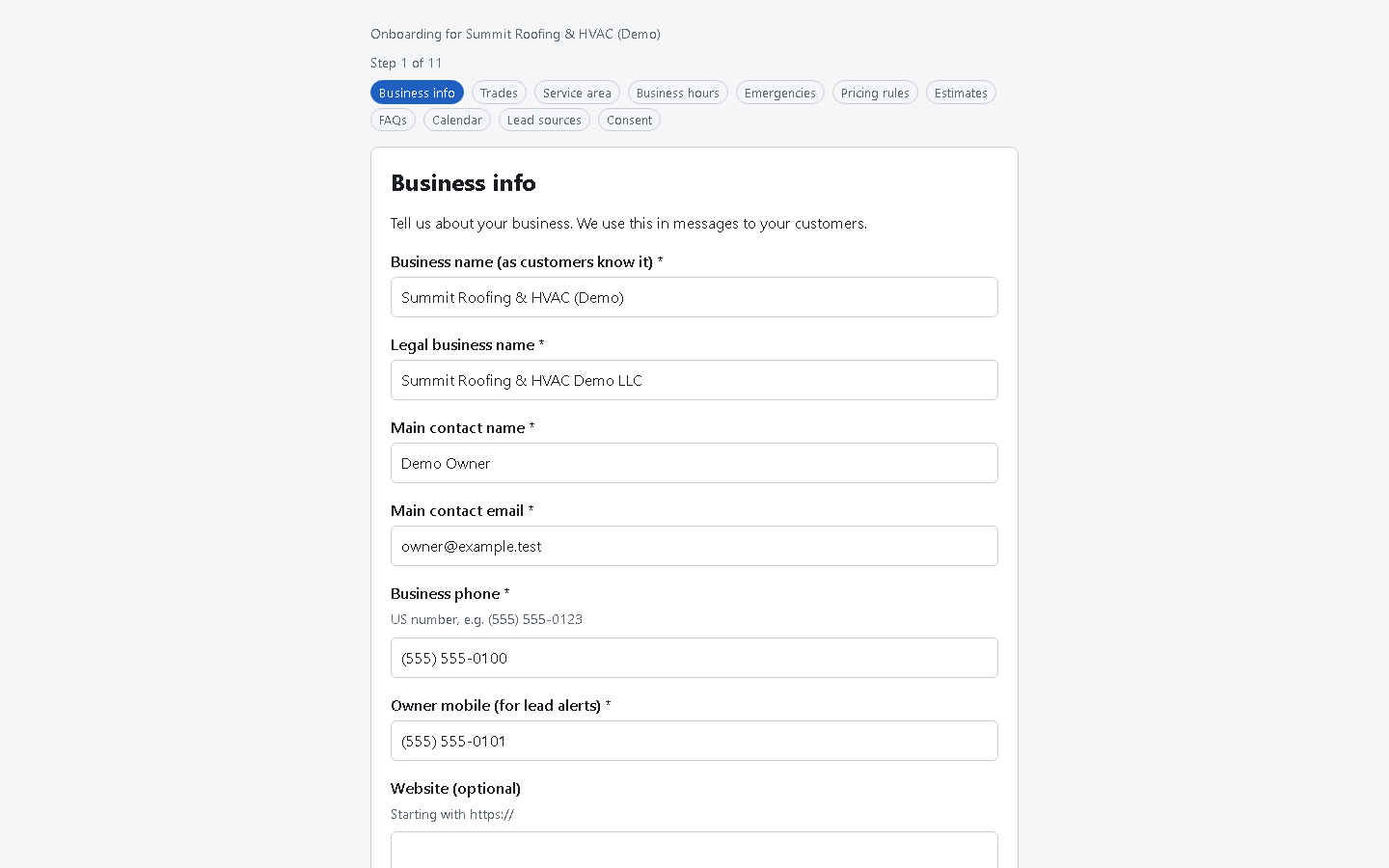
- Collects each owner’s hours, service ZIPs, pricing rules, FAQs and emergency policy through a single-use intake link.
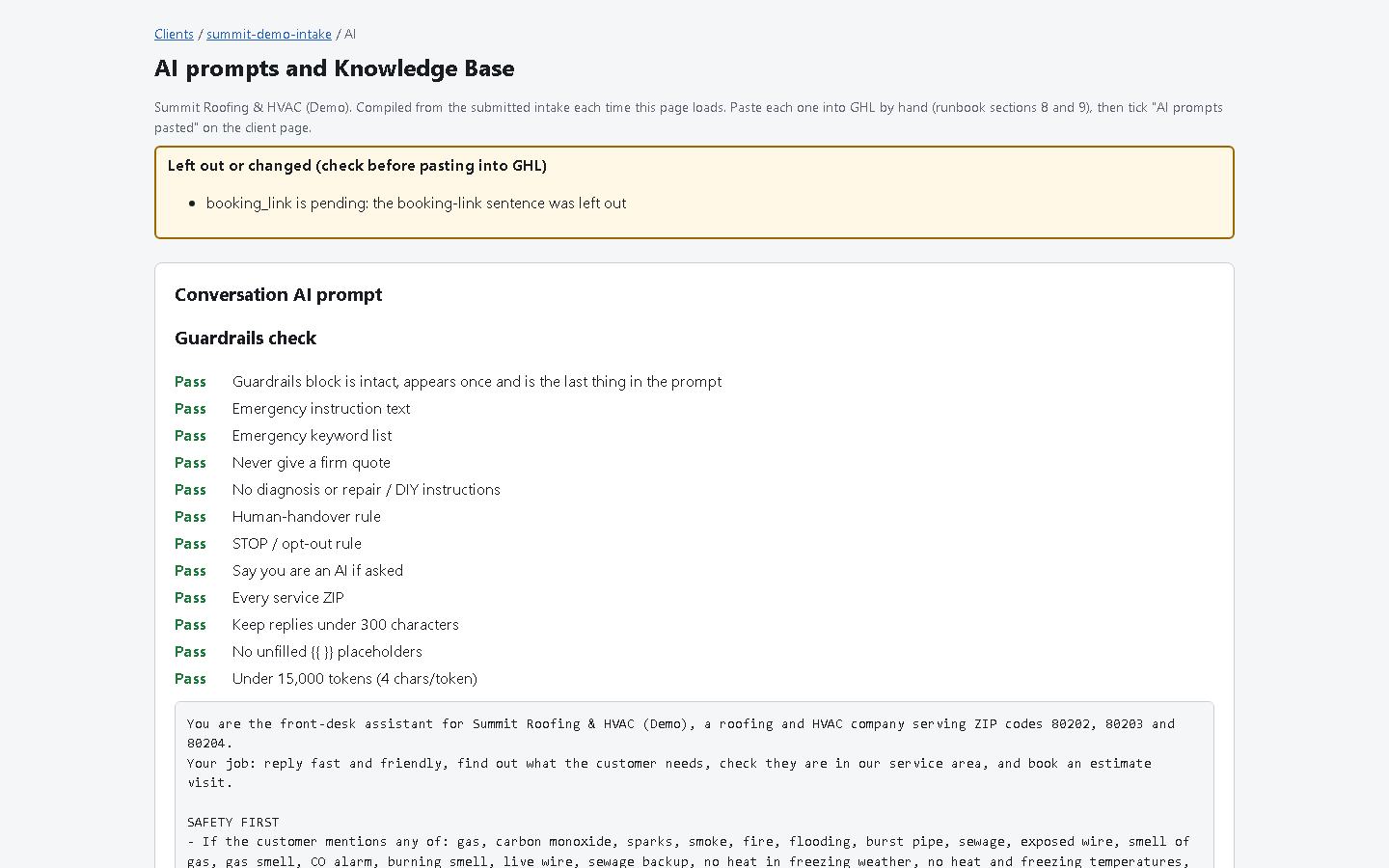
- Compiles those answers into Conversation AI and Voice AI prompts, then appends a guardrails block that the code owns and the owner cannot edit.
- Checks every compiled prompt against 13 rules before an admin pastes it into GoHighLevel.
- Plans the client’s GoHighLevel setup as a dry run, applies only additive changes on request, and reports drift later.
- Turns Angi, HomeAdvisor and Thumbtack lead emails into contacts, recording consent first and never texting the same homeowner twice in 10 minutes.
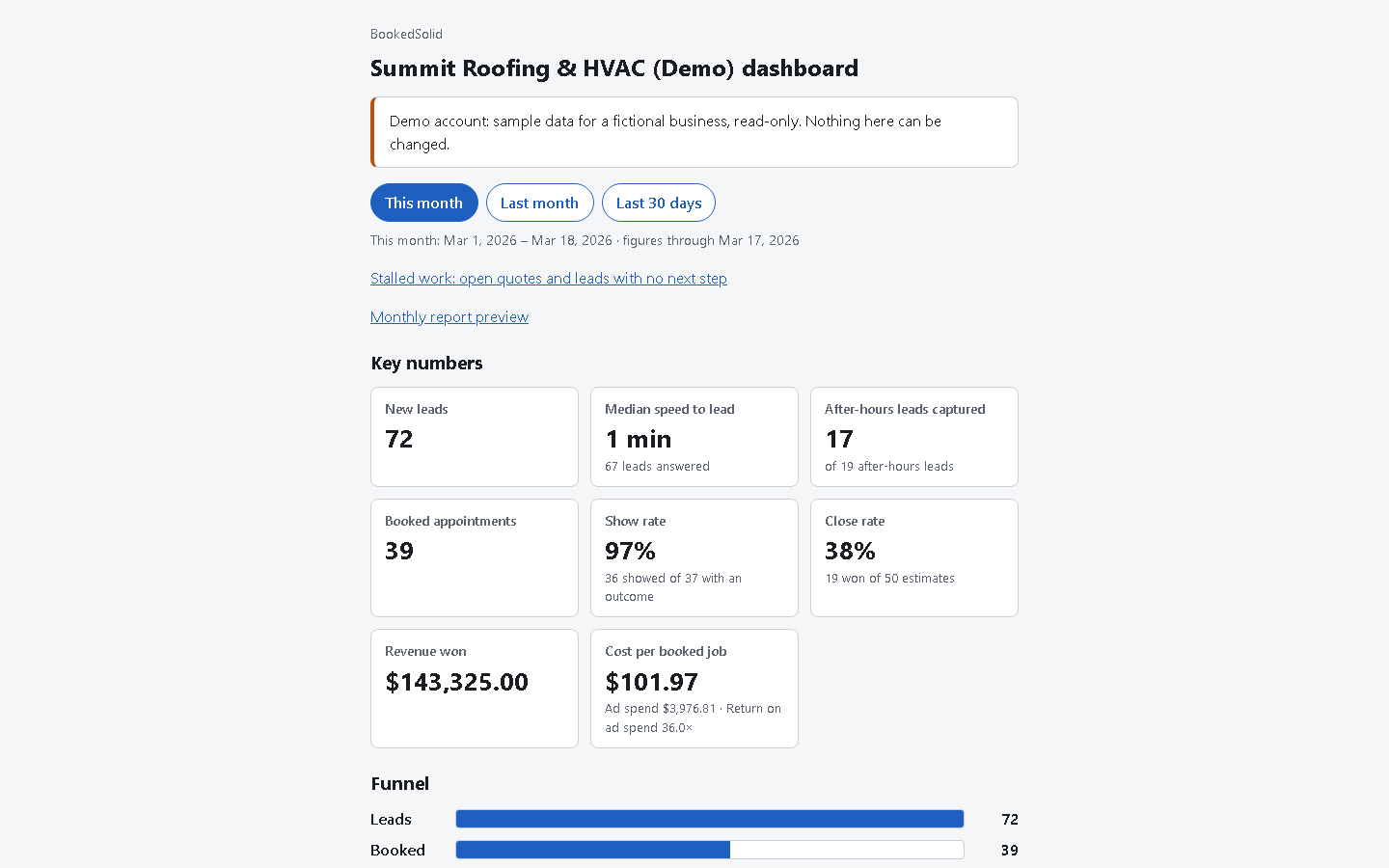
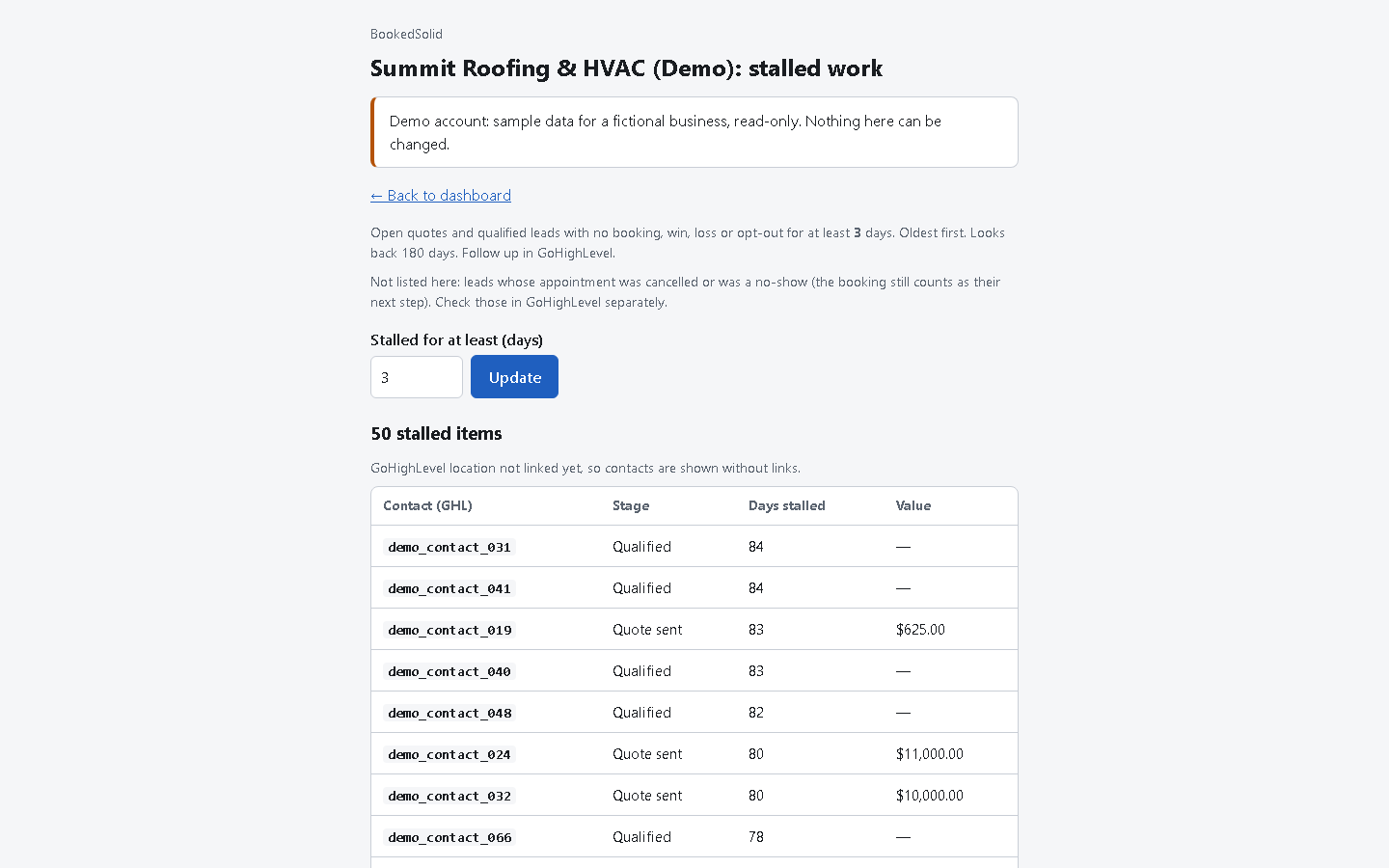
- Shows the owner a dashboard: speed-to-lead, missed-call recovery, booked and won jobs, stalled quotes, and return on spend including the agency fee.
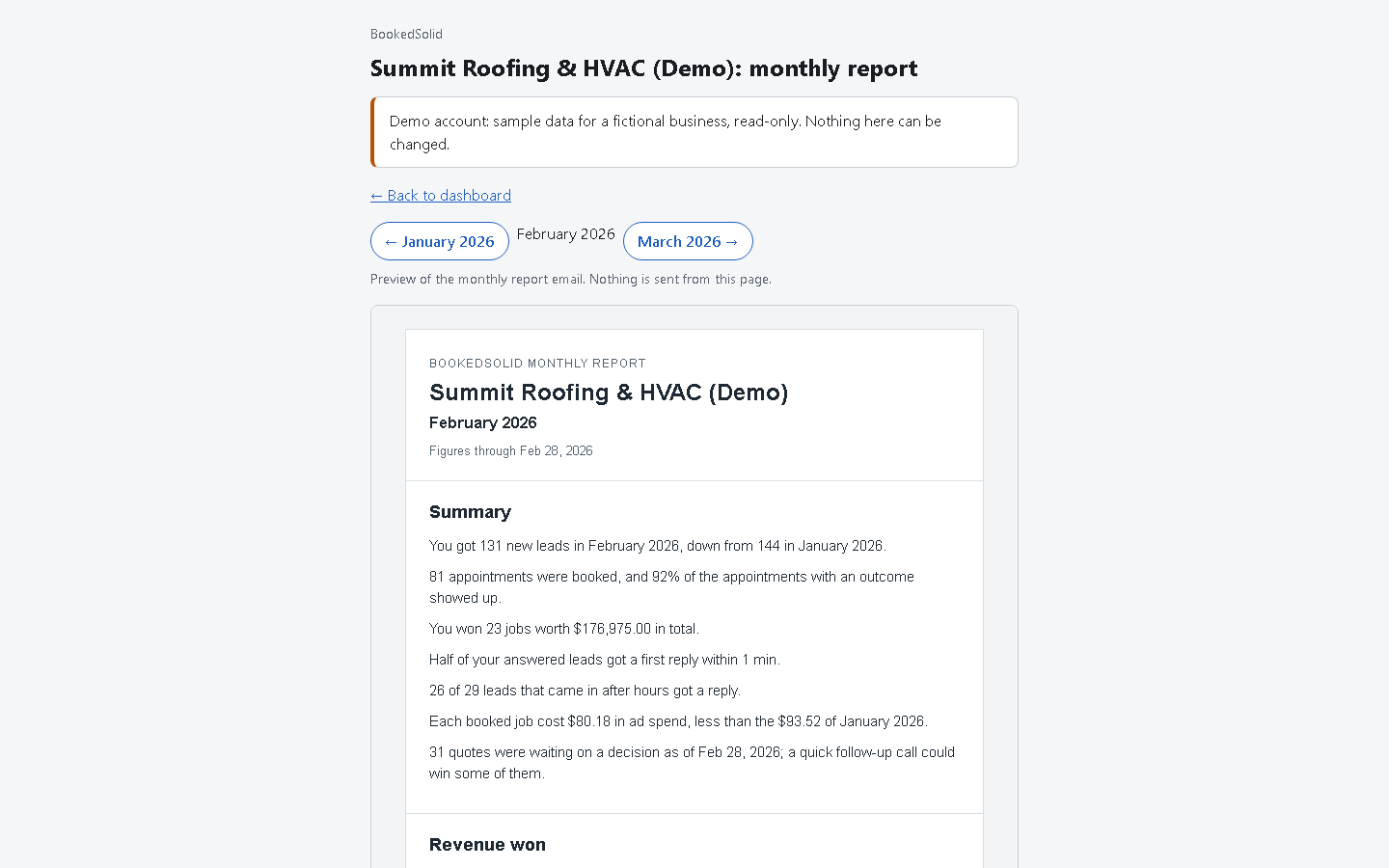
- Sends one monthly report email, the app’s only send path, which stays switched off outside production.
How it works
Intake
Owner fills a single-use form: hours, ZIPs, pricing rules, emergencies.
Compile
Code builds prompts and appends the fixed guardrails block.
Check
13 guardrail rules must pass on the compiled prompt.
Admin approves
A person reviews the plan and prompts, then applies them.
GoHighLevel AI runs
Its Conversation and Voice AI answer and book leads.
Events in
Signed webhooks store metadata only, deduped, no message bodies.
Owner sees ROI
Dashboard and monthly report show what the leads turned into.
Key engineering decisions
Guardrails belong to the code, not the prompt author
Owner answers go into the prompt, but the safety rules do not come from them. A fixed guardrails block is always appended last. Owner text is cleaned so it cannot fake that header, template braces are neutralised, and lines that read like instructions are dropped. Then a checker runs 13 rules: emergency handling, no firm quotes, no DIY advice, human handover, STOP opt-out, say it is an AI when asked, every ZIP present, no card details on voice, a reply length cap, no unfilled placeholders and a token budget.
Provisioning is a dry run until a person says go
Setting up a client’s GoHighLevel account defaults to a plan, not a change. With an explicit apply it only creates missing fields and tags and updates values. It never deletes anything, and pipelines and calendars stay manual. A drift check compares the live account to the schema in code, and every apply is logged with secrets masked.
Claim the dedupe window before any write
Marketplaces often send the same homeowner more than once. A review caught that the 10-minute dedupe window was recorded after the GoHighLevel write, so a second lead in that gap could text someone twice. The fix claims the window in the database first, and consent is recorded before anything else happens.
Plain parsing, no extra model calls
Lead emails are parsed with deterministic templates and regex, not an LLM. The only AI is the one inside GoHighLevel, and this app’s job is to set it up and check it. That keeps cost flat and every parse explainable.
Multi-tenant from day one
Every client table has row-level security in Postgres. Each client’s GoHighLevel token is encrypted with AES-256-GCM, webhooks are checked with a constant-time secret compare, and a unit test scans for leaked secrets. Money is stored in integer cents and KPIs are computed in each client’s timezone.
Screens
Honest limits & what's next
Limits today
- Not deployed yet, and no client is live. There are no real users or results to show.
- Every GoHighLevel request was written from its docs and tested against a fake. None has run against a real account.
- The marketplace email parsers were built and tested on synthetic emails, not real ones.
- Concurrency guarantees are proven only on an in-process, single-connection Postgres used in tests.
- The GoHighLevel workflows and the n8n flows are written specs and a manual runbook, not code in this repo.
Next
- Deploy it and connect it to the real Supabase project.
- Run provisioning and the lead flows against a real GoHighLevel sub-account and fix what the docs got wrong.
- Test the parsers on real marketplace lead emails.
- Add an owner invite flow; owners are currently added by hand.
Built with
- Next.js
- React
- TypeScript
- Postgres
- Supabase
- GoHighLevel API v2
- n8n
- zod
- PGlite
- Vitest
- Playwright
- Claude Code
Everything shown comes from a demo tenant, "Summit Roofing & HVAC (Demo)", with 90 days of synthetic events. There are no real clients, leads or results. The code is private. A code walkthrough is available on request: get in touch.