InquiryOps
Turns customer inquiries into tracked cases, with replies a person approves before anything goes out.
Oct to Nov 2026 · Solo: spec, architecture, build
InquiryOps takes inquiries for cleaning and event-service businesses from a web form, a pasted message or a connected Gmail inbox and turns each one into a case. An AI pulls out the details, but every detail has to point at the exact words in the message. Plain code works out the estimate, a person approves the reply, and the app can only save a Gmail draft. It has no way to send email.
- synthetic inquiries extracted exactly right in the live eval
- 37/42
- valid reply plans in the live reply eval
- 42/42
- versioned database migrations
- 37
- AI spend: Groq free tier, no paid fallback
- US$0
The problem
Small service businesses get inquiries that are missing half of what they need to quote. What size is the place? How often? Where? Someone has to read each message, work out what is missing, ask for it, and then price the job.
An AI can draft that reply in seconds. The risk is that it fills the gaps with guesses, invents a price, or sends something nobody checked. For a business talking to its own customers, that is worse than a slow reply.
So I wanted a tool where the AI only reads and suggests, every fact can be traced back to the customer's own words, prices come from rules the owner approved, and nothing leaves without a person saying yes.
Who it's for
Owners and office staff at small cleaning and event-service businesses who handle inquiries by email or web form. Accounts are invite-only, with owner and operator roles inside a workspace.
What it does
- Takes inquiries three ways: a public form, a pasted message, or labelled emails from a connected Gmail inbox.
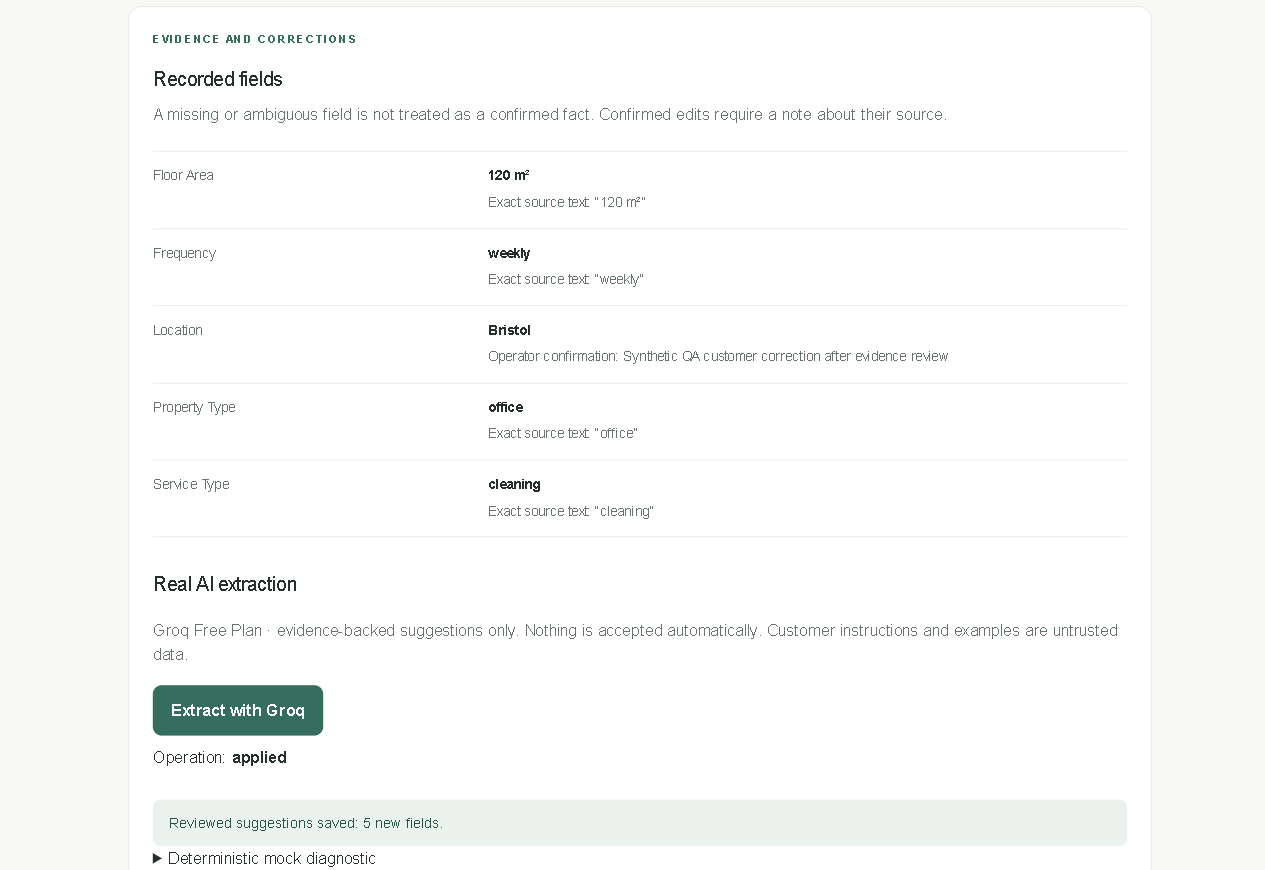
- Uses Groq to suggest the key details (service, property type, location, floor area, frequency). Each suggestion must quote its exact place in the message, and nothing is saved until a person reviews it.
- Lets the operator correct any field, but a manual change needs a note saying how the customer confirmed it.
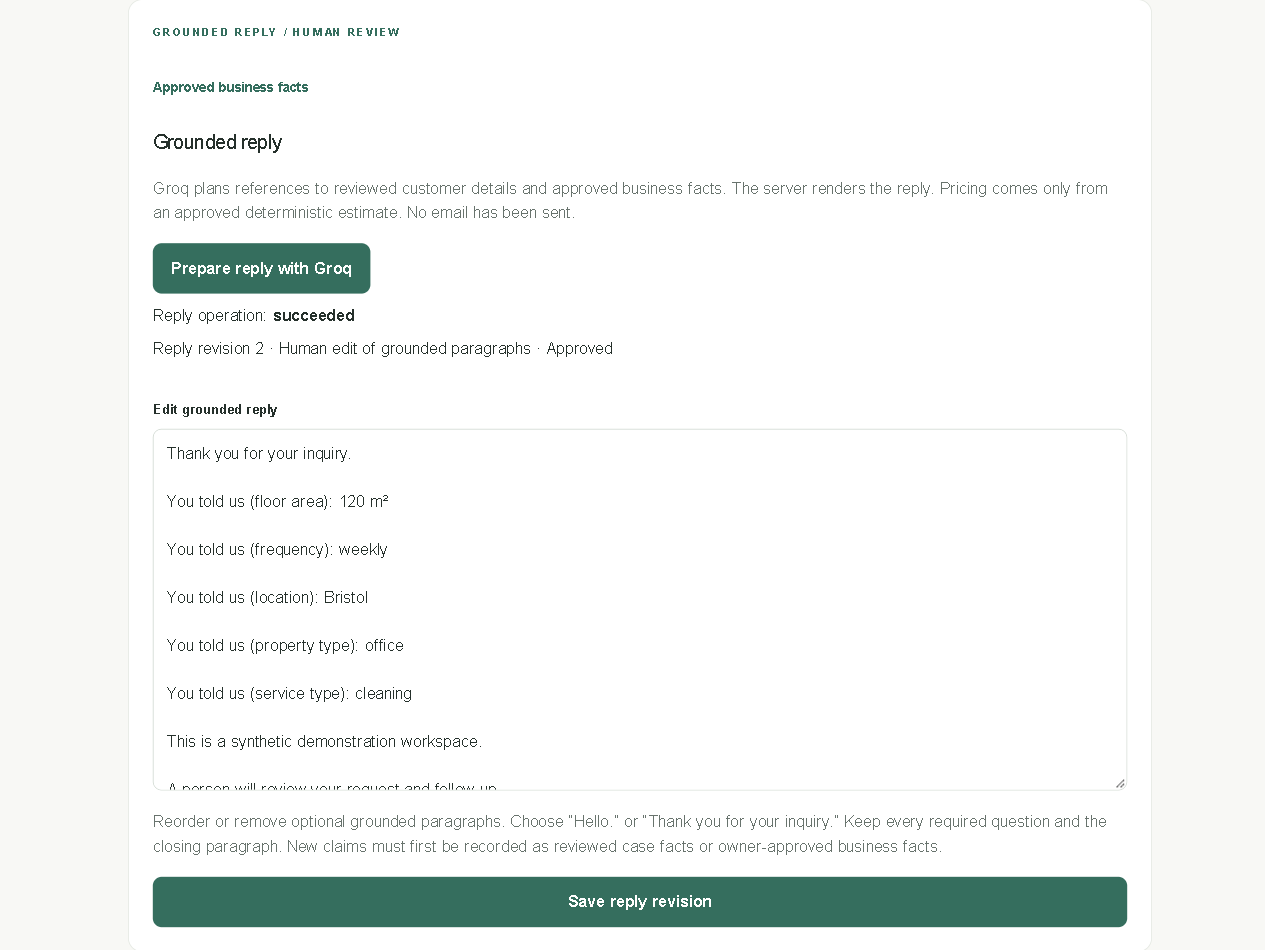
- Prepares a reply that only uses confirmed case facts, approved business facts and the questions still open. The server writes the final text, so the model cannot add its own claims.
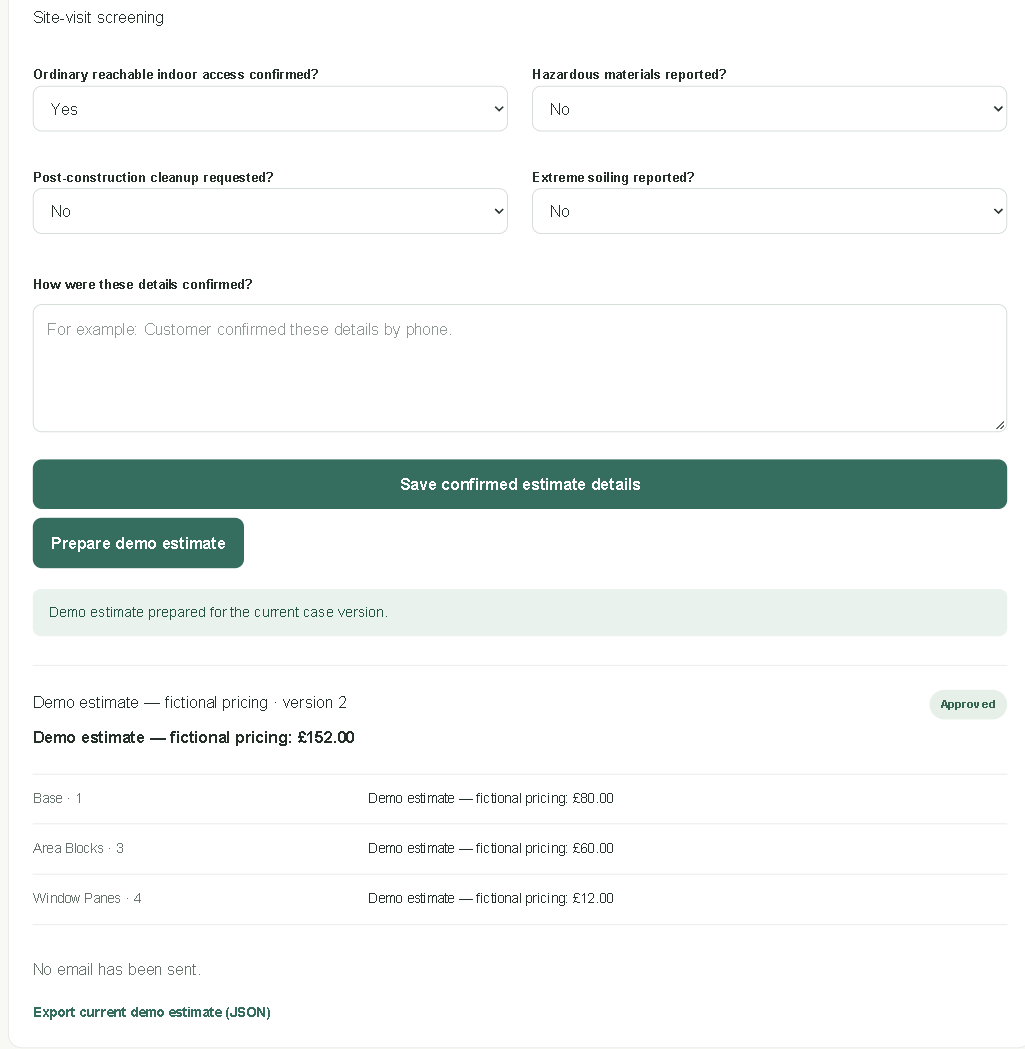
- Works out a demo estimate in plain code from owner-approved rules, with site screening questions that block a total when something is unknown or risky.
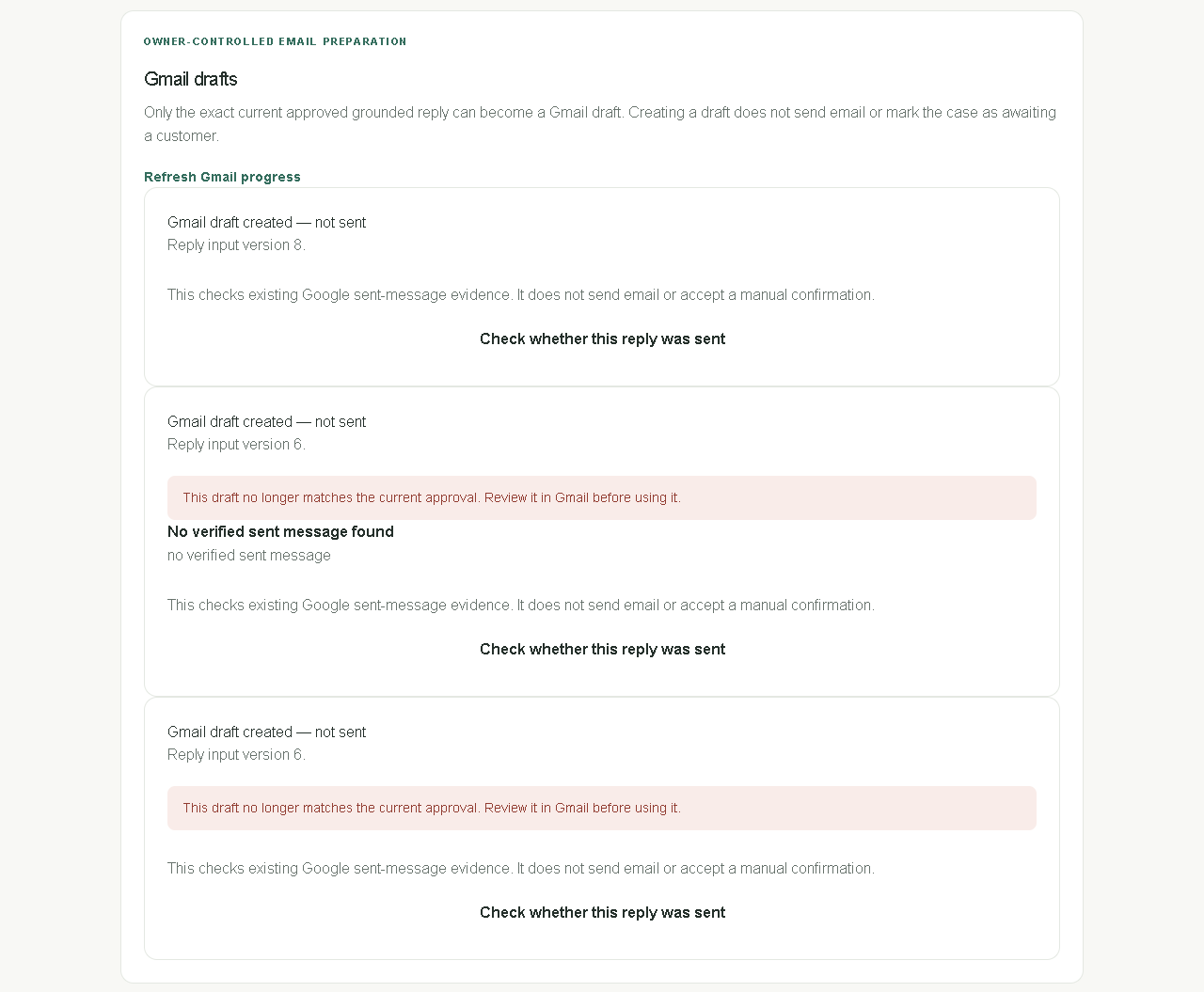
- Creates a Gmail draft of the approved reply. It never sends. It can check Gmail afterwards for proof that a person sent it.
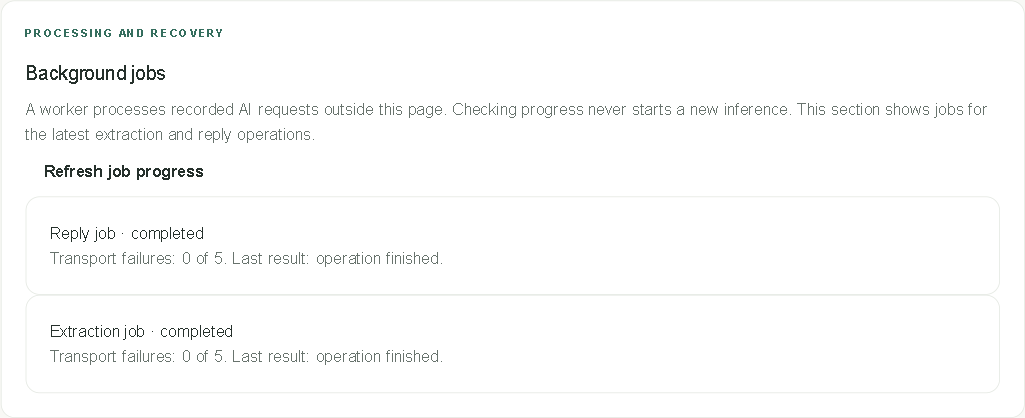
- Tracks follow-up tasks, case history and background jobs, so every change and approval is on record.
How it works
Intake
Public form, pasted message or a labelled email from the connected Gmail inbox.
AI suggests
Groq proposes case details, each tied to the exact span of text it came from.
Check evidence
Code confirms every span matches the message. Missing or unclear fields stay unresolved.
Person reviews
An operator accepts or corrects the details. Corrections need a confirmation note.
Reply and estimate
The model picks references, the server writes the reply, and SQL works out the price.
Owner approves
Approval is tied to the current case version. Any relevant edit cancels it.
Gmail draft
The approved reply becomes a draft in Gmail. A person decides whether to send it.
Key engineering decisions
The AI reads. Code and people decide.
Groq is used for two narrow jobs: suggesting case details and choosing which confirmed facts a reply should mention. It never writes free text that reaches the customer and never does arithmetic. Estimates are integer pence calculated in SQL from approved rules, and the client cannot pass in its own total.
Every fact points at the customer's words
Each extracted value carries the start and end of the text it came from, and the database rejects a span that does not match the message. A field with no evidence stays missing or ambiguous rather than being guessed. Customer text is treated as untrusted data, and the eval set includes adversarial messages that try to steer the model.
Drafts only, by design
The Gmail connection asks for read and compose access, and the app has no send action at all. A case only moves to "awaiting customer" when Gmail shows real evidence that a person sent the approved reply. If a draft's outcome is uncertain, the app checks Gmail read-only instead of creating a second draft.
Approvals expire when the facts change
Reply and estimate approvals are bound to the exact case version. Editing a customer detail, a required field list, an approved business fact or a pricing rule invalidates them in the same database transaction, so an old approval can never ship new content.
Safe retries and tenant walls in the database
Tables use row-level security, writes go through narrow database functions that check who is asking, and workspaces cannot see each other. AI and Gmail work runs in separate workers with leases, so a retry does not quietly repeat a model call or a draft. CI spins up a throwaway Supabase stack and runs the SQL smoke tests and a rollback round trip on every pull request.
Screens
Honest limits & what's next
Limits today
- Only synthetic inquiries and a dedicated test mailbox have been used. The eval measures the model against my own answer key: 5 of 42 synthetic cases still came out wrong.
- Prices are fictional demo rules. Real-client pricing approval is switched off in the database.
- The hosted demo ran on a free Render service with workers on my own machine. It is offline right now and the database is paused.
- A real pilot needs Google verification for the Gmail scopes, a data retention and purge process, and self-service onboarding. None of those are done.
Next
- Bring the demo back online with synthetic data so it can be clicked through.
- Finish the retention and purge process needed before any real customer data.
- Run a pilot with one cleaning or events business, with their permission.
Built with
- Next.js 16 (App Router)
- React 19
- TypeScript
- Supabase Auth + Postgres + RLS
- Groq (gpt-oss-20b)
- Gmail API
- Zod
- Tailwind + shadcn/ui
- Vitest + pgTAP
- Playwright
- GitHub Actions
- Render
Every inquiry, customer, business and price shown is synthetic, and the Gmail tests used a dedicated test mailbox. The repository is private; I can walk through the code on request. The code is private. A code walkthrough is available on request: get in touch.