Kairo
My own AI assistant. It does the legwork, and nothing risky happens without my tap.
Nov 2026 · about 10 days · Solo: spec, architecture, review. Built with a Claude Code agent team
“I ran my day on Grok bots and studied NousResearch's Hermes Agent. Eventually I wanted one assistant I fully understood and controlled, so I'm building my own.”
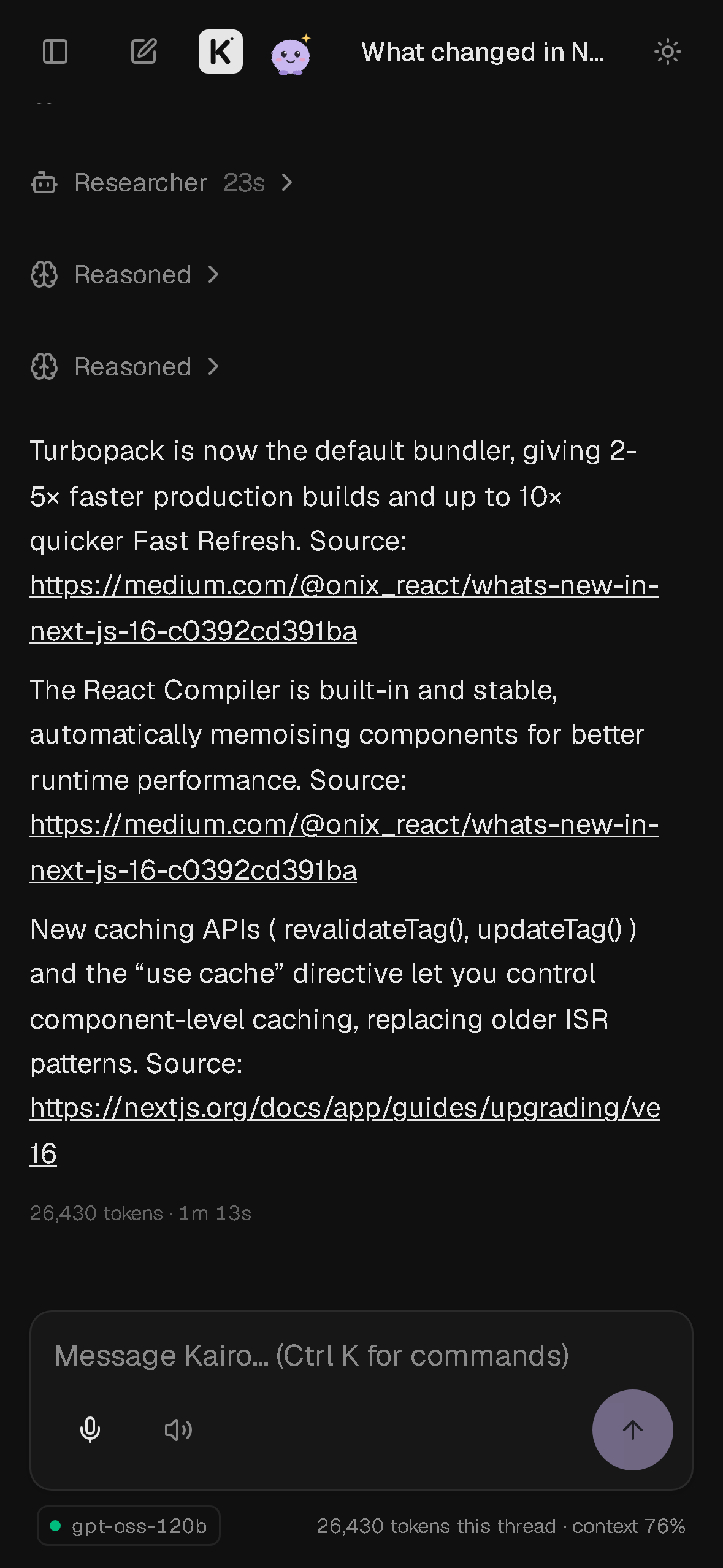
Kairo is a personal AI agent I use every day. A root orchestrator hands work to seven specialist bots for research, shopping, code, a cloud browser, email, my apps and my PC. It has its own inbox: it triages and drafts, and it sends only after I tap Approve. It runs on free-tier models, so most of the engineering went into fitting an 8k-token budget and staying safe.
- specialist bots
- 7
- apps connected
- 6
- whitelisted PC actions
- 4
- self-test suites
- 21
- to build
- ~10 days
The problem
I was paying for and juggling separate AI tools. My go-to-market notes lived in a Grok bot, and when that subscription ended, the knowledge went with it. I wanted one assistant that could research, write code, handle email, act on my apps and remember things about me.
It also had to be safe to trust. An agent that can send email or write to my Notion can also be tricked by a web page or an email into doing something I never asked for. So the rule was simple: the AI can read and propose, but anything that sends, writes or changes memory waits for me.
And it had to cost nothing. Groq's free tier caps each request at about 8k tokens. That one limit shaped almost every design choice.
Who it's for
Me. Kairo is a single-user assistant behind a login. Other AI agents I use, like Claude Code, can borrow its tools over MCP, but they can never approve anything.
What it does
- Researches topics on the web and reads pages, with a cloud browser for sites that need clicking.
- Pulls recent GitHub commits and helps me review pull requests.
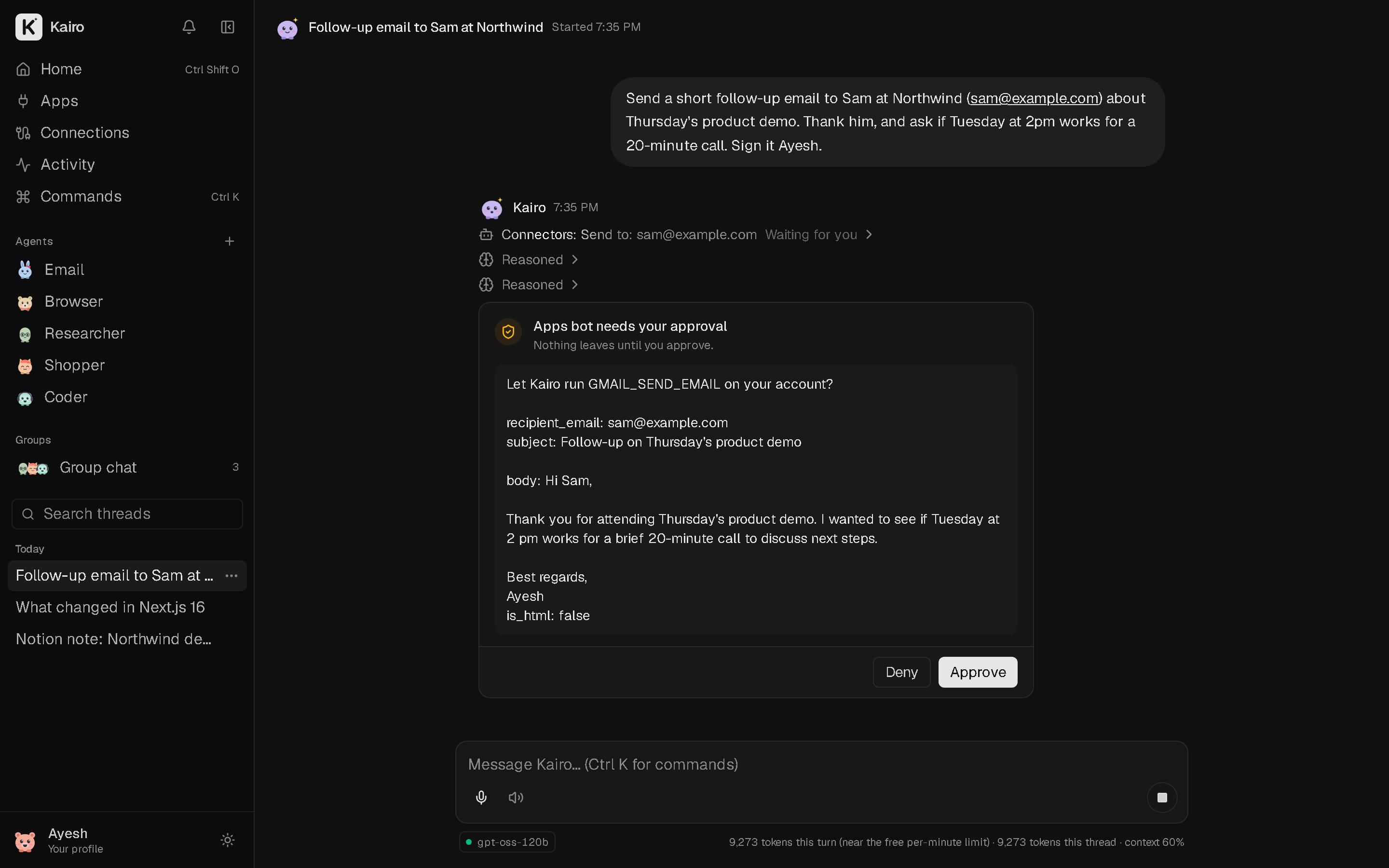
- Runs its own email inbox: it triages threads and drafts cold emails and replies. Nothing is sent until I tap Approve.
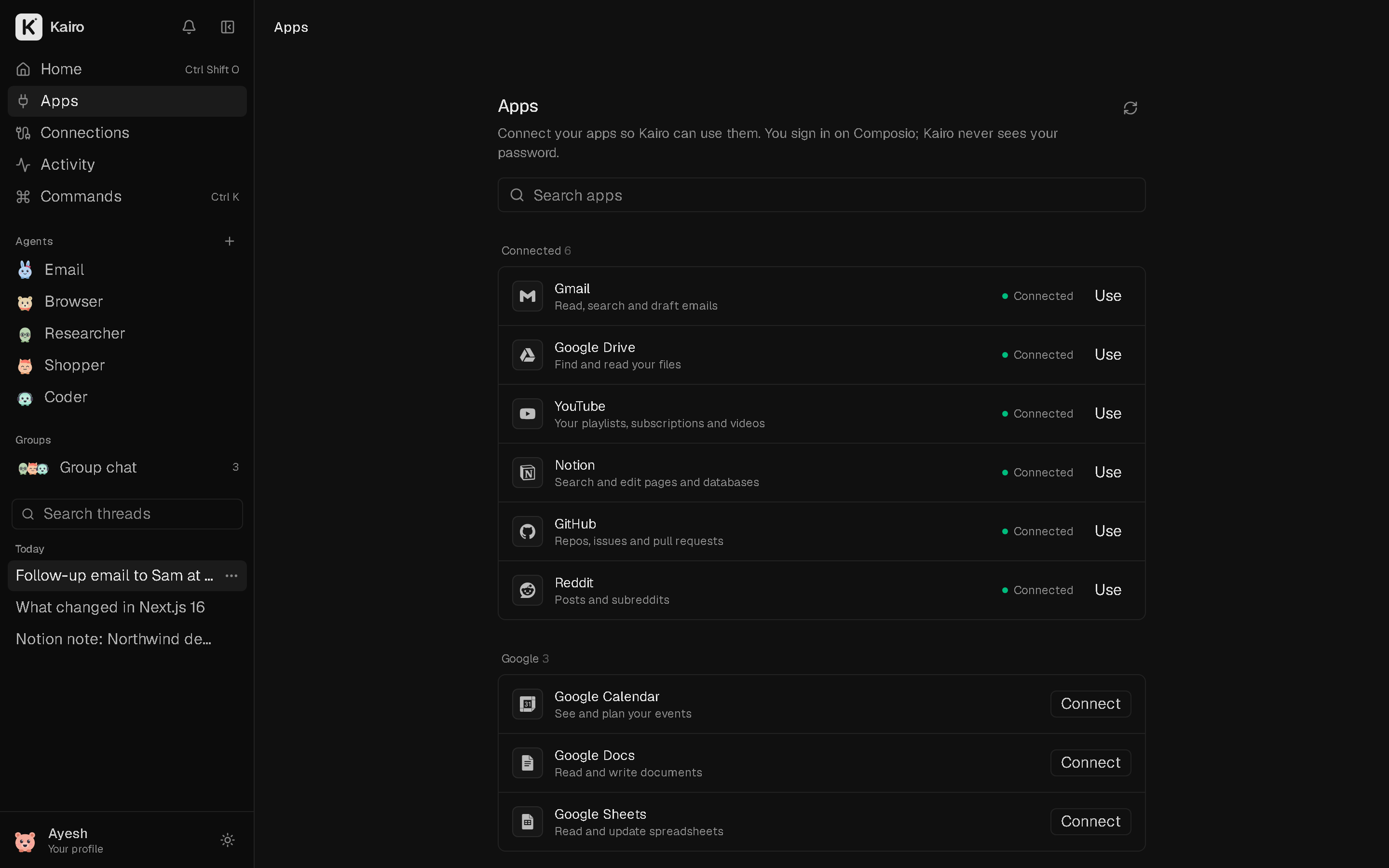
- Works in my apps through Composio: Gmail, Google Drive, Notion, GitHub, Reddit and YouTube today, and I can add others like Slack, Linear or Canva. I use it to push notes to Notion. App writes need my approval.
- Controls my Windows PC through a small helper with four fixed actions: status, keep awake, allow sleep and play music.
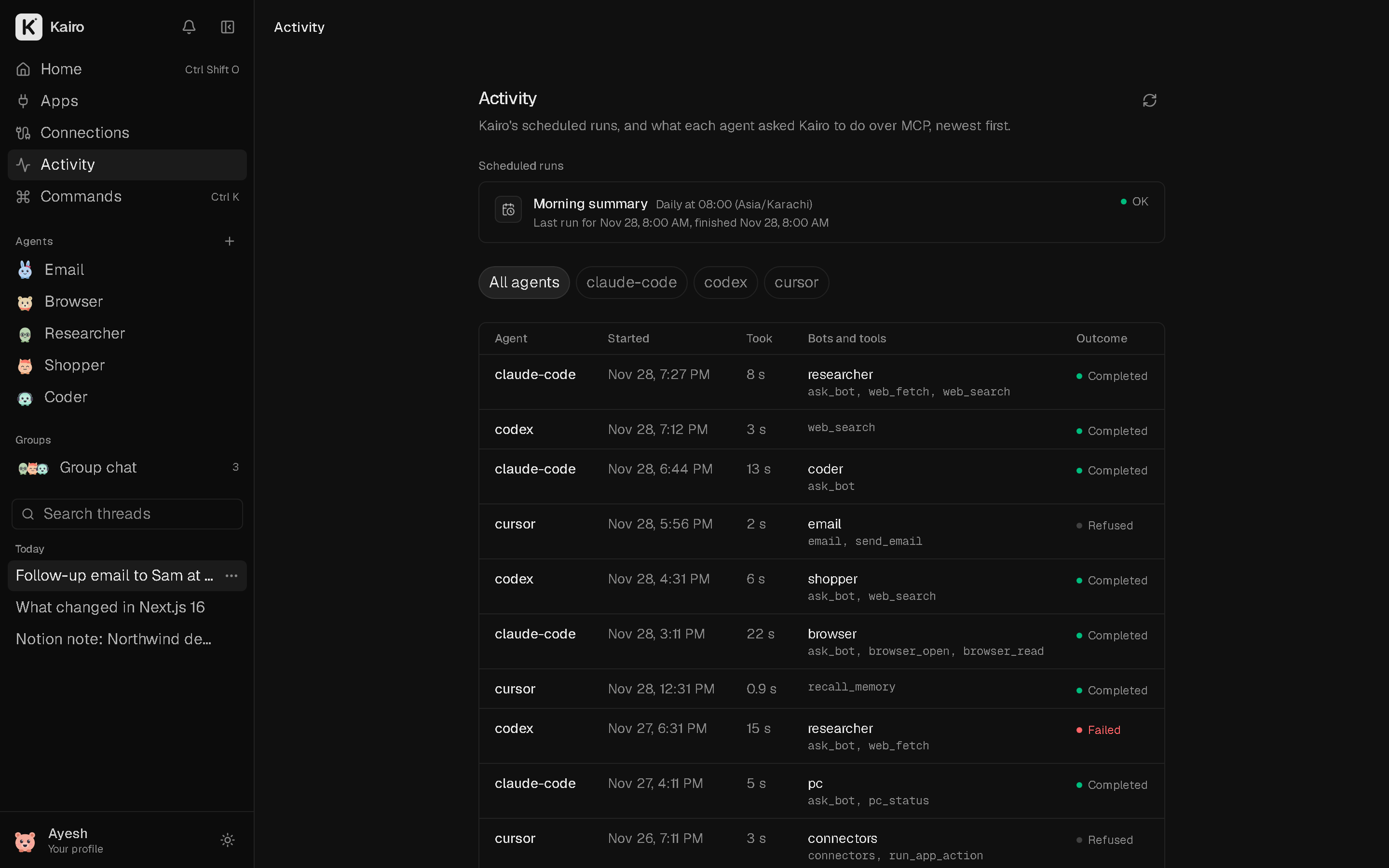
- Builds a morning digest of unread email at 08:00 in plain code, with no model call, and posts it to the app’s Activity page.
- Acts as an MCP server, so Claude Code can call Kairo's tools with its own token and ability list.
How it works
I ask
From the web chat, the phone app, or Claude Code over MCP.
Root orchestrator
Plans the task. It has no shell or file access of its own.
ask_bot
One blocking call hands the job to the right specialist bot.
Specialist works
Research, code, browser, email, apps or PC. Outside content is fenced as untrusted.
Policy check
Plain code decides: reads go through, sends and writes are held.
I approve
An Approve or Deny card. Nothing risky runs without my tap.
Logged
The Activity log records who did what and how it ended.
Key engineering decisions
Designed around an 8k-token budget
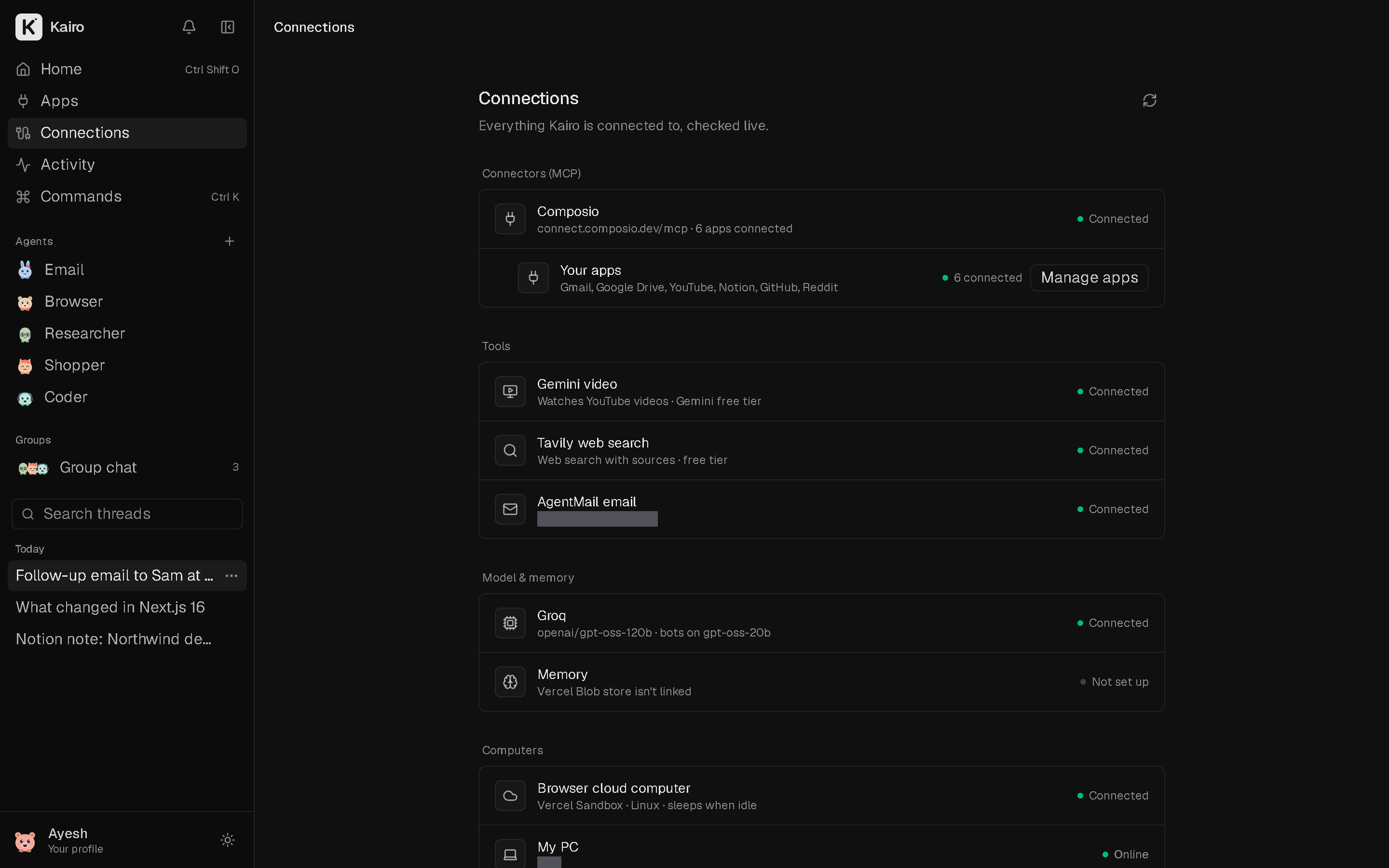
Groq's free tier allows about 8k tokens per request, so the root runs gpt-oss-120b and the bots run gpt-oss-20b to split the rate limits, with context windows set just under the cap. Composio's tool schemas alone are about 8k tokens, so I wrapped them in three small tools. Old tool results are trimmed to one line, long chats are compacted, and a self-test fails if the system prompt grows past its size limit.
One workflow tool for delegation
The root reaches most bots through a single blocking ask_bot tool. That cuts each hand-off from three or more root model calls to two, which matters a lot when every call counts against a free quota. The email and apps bots stay as native subagents so their Approve cards show up in the chat.
Human approval lives in one policy file
Email sends, app writes and memory changes all go through one approval policy. I get an Approve card; other agents calling over MCP get a plain refusal instead, so they can never approve on my behalf. Each MCP agent has its own hashed token and a list of abilities it may use, checked on every tool call. Scheduled runs get no tools at all. Memory is governed the same way: agents can only propose a change, and the proposal goes stale if the entry changed in the meantime.
Treat everything from outside as untrusted
Web pages, emails and app content are fenced as untrusted data. A threat-pattern scanner flags injection attempts and blocks them from memory, invisible characters are stripped, and stored memories are screened again on recall. Fetches block private, loopback and cloud-metadata addresses, check every redirect, and pin the connection to the vetted IP to stop SSRF. Several of these ideas are adapted with attribution from NousResearch's Hermes Agent.
Fail soft, and use plain code where it is safer
A resilience layer paces and retries rate-limit errors, swaps between the two Groq models, falls back to Gemini, and watches the stream for stalls before giving a clear busy message. Where a model adds risk but no value, I left it out: the morning digest and the email reply alerts are built in code. The PC helper only accepts signed, expiring jobs for four fixed actions, and never runs arbitrary commands.
Screens
Honest limits & what's next
Limits today
- Single user. There are no other users or customers, and it is not built to be multi-tenant.
- It does not act on email by itself. It only alerts me when someone replies to mail it sent, and every send needs my tap.
- PC control is narrow on purpose: four actions, no apps, no commands, no files.
- It depends on free tiers (Groq, Gemini, search credits), so heavy days can hit limits and slow it down.
- Some production paths are still being checked, like the cloud browser sandbox settings and the phone app on real devices.
Next
- Finish the post-deploy checks on production and widen the live QA cases.
- Add more PC actions, one at a time, each signed and whitelisted.
- Turn more of my weekly routines into code-built digests that need no model.
Built with
- TypeScript
- eve (Vercel agent framework)
- Vercel AI SDK
- MCP
- Groq
- Gemini
- Composio
- AgentMail
- Next.js
- Vercel Blob & Sandbox
- PowerShell
- zod
Kairo runs on my own accounts and data, so there is no public demo. The app sits behind a login. The code is private. A code walkthrough is available on request: get in touch.