HVAC office tools
Small tools that catch the calls, callbacks and payments a busy HVAC office drops.
Nov 2026 · Solo: spec, architecture, build
Five demo apps for small HVAC shops, led by Fieldline: missed-call text-back where a person approves every text before it goes out. Plain rules sort each lead and draft the reply, guardrails block risky wording, and sending stays off by default. Four smaller tools cover morning callbacks, after-job follow-ups, new inquiries and payment mismatches.
- demo apps
- 5
- lead buckets in the rules qualifier
- 6
- outbound guardrail checks
- 8
- promptfoo eval cases
- 7
- Fieldline test files
- 18
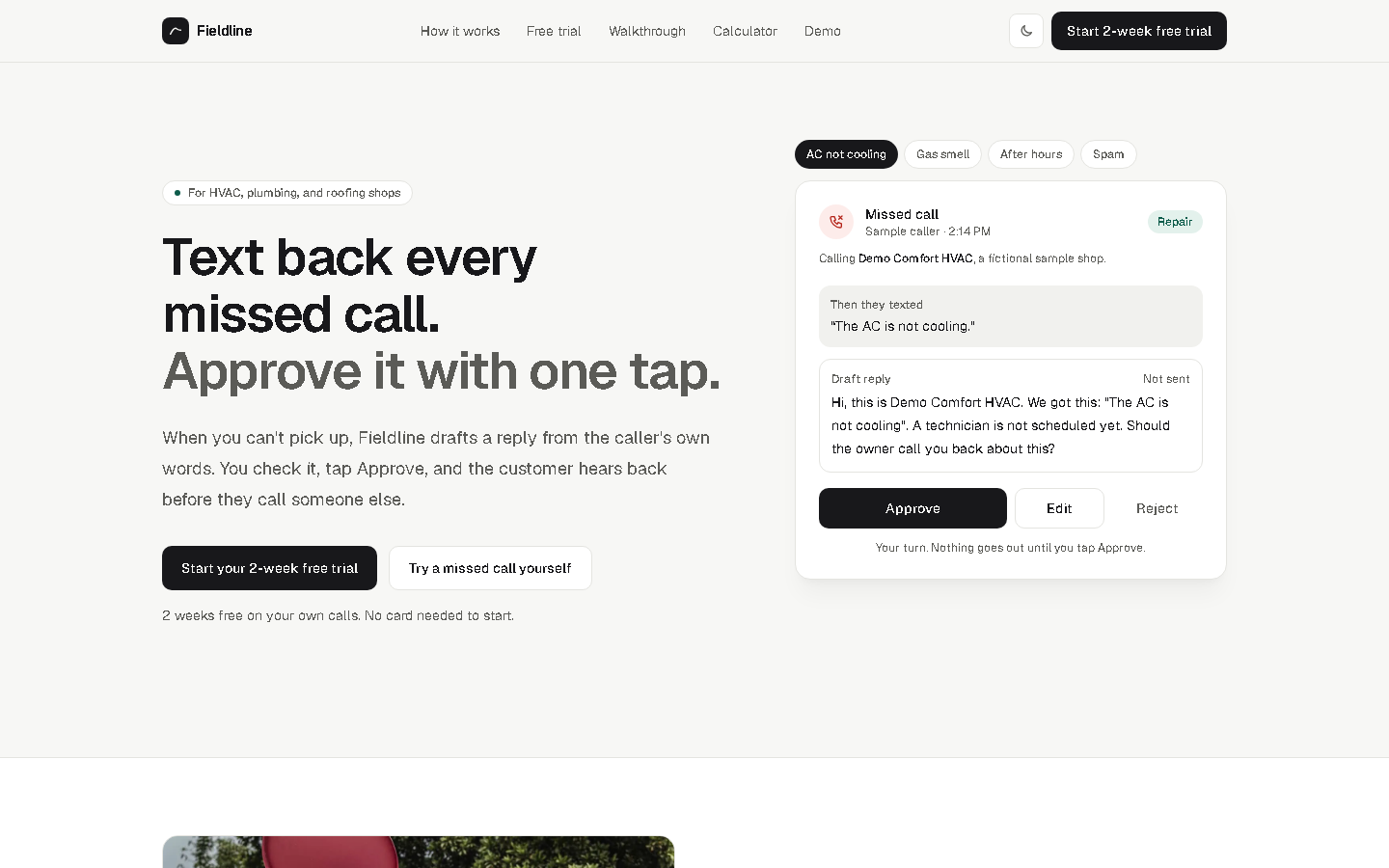
The problem
A small HVAC shop has its crew on roofs and under houses. Nobody has the phone as their only job. So work slips through the gaps.
A caller hangs up and dials the next shop. A night caller is promised a morning callback that nobody remembers. A WhatsApp inquiry sits for a day. A payment bounces in Jobber, but the invoice still reads paid.
Auto-replies can fix some of this, but a wrong text to a customer is worse than no text. It might promise a time, quote a price, or give repair tips during a gas leak. I wanted the speed of automation with a person still in charge of what gets sent.
Who it's for
Owners and office staff at small US HVAC shops. Fieldline is also built to work for plumbing and roofing shops, and for GoHighLevel agencies that run phones for shops like these.
What it does
- Fieldline catches a missed call, text or form from GoHighLevel and sorts it into emergency, repair, maintenance, install quote, spam or out of area.
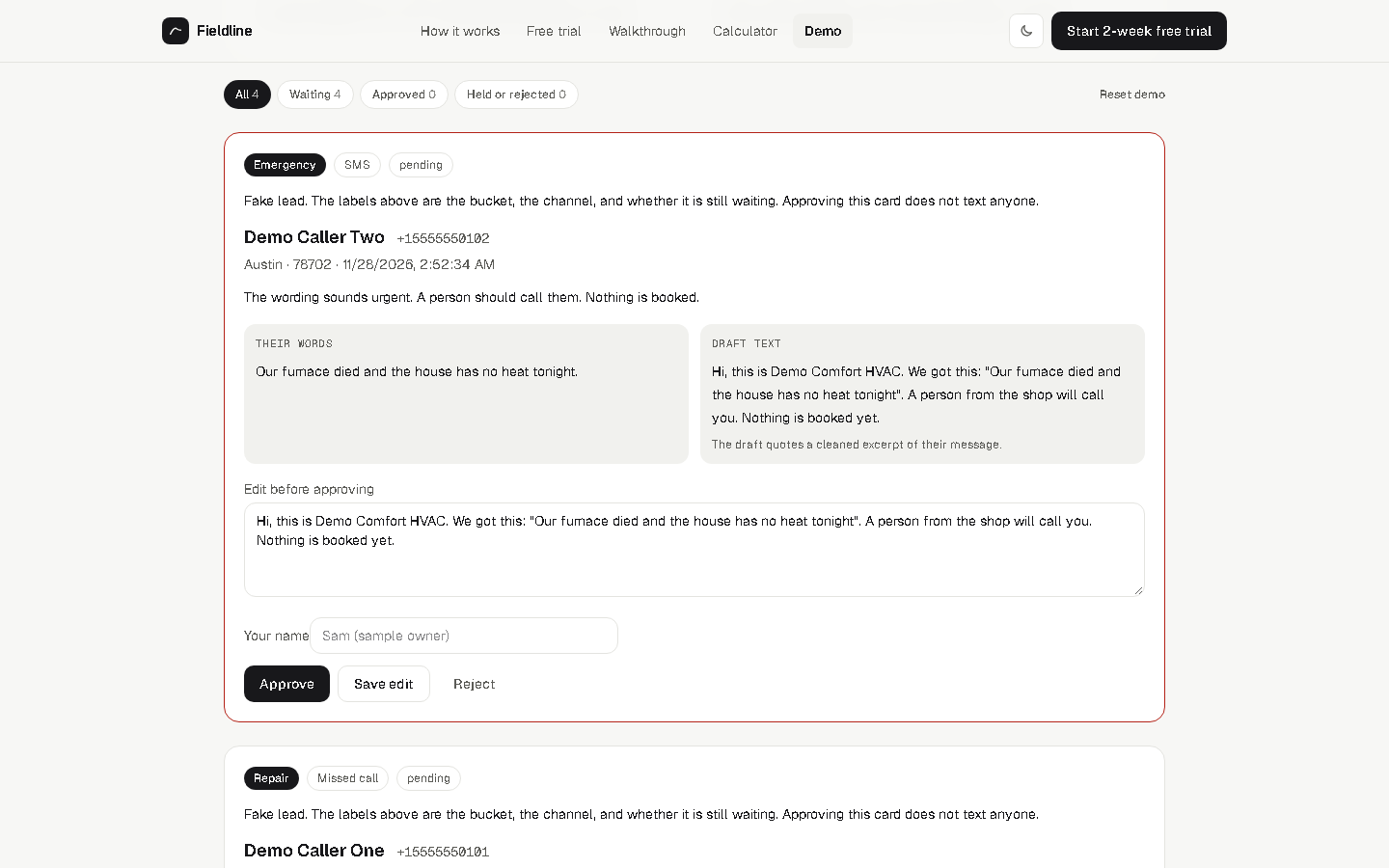
- It drafts a short reply that quotes the caller, then puts it in a queue where a person approves, edits or rejects it.
- Emergencies alert the owner before any customer text. Gas or CO replies only say to leave and call 911, with no repair steps.
- Non-urgent drafts wait for quiet hours to end (9pm to 8am in the lead's time zone). Spam and opt-outs cannot be approved at all.
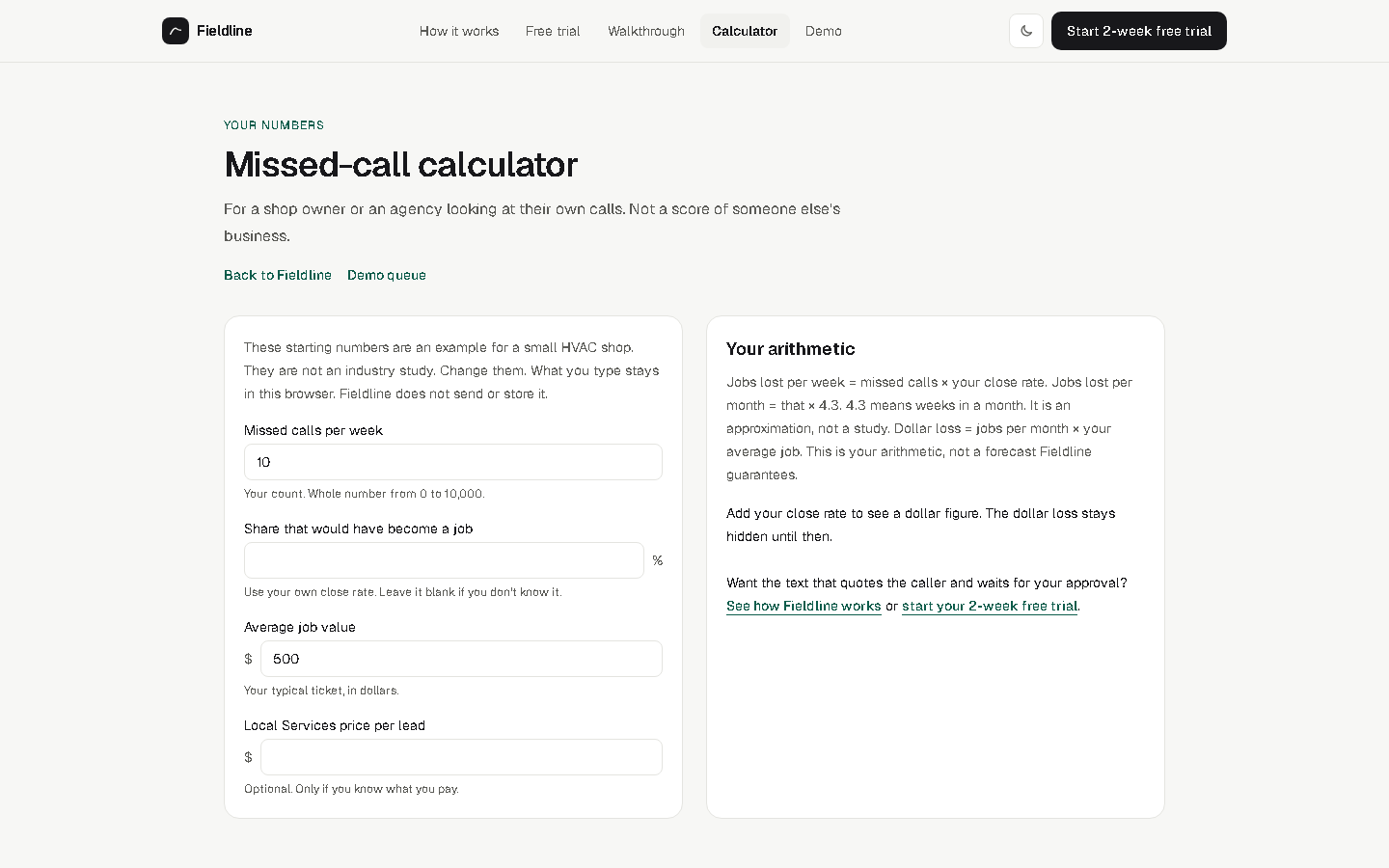
- A browser demo on the homepage runs the real rules on sample calls, and a missed-call calculator runs in the browser and stores nothing.
- Four sibling tools keep one list each: morning callbacks, after-job follow-ups, new inquiries, and payments that did not match.
How it works
Lead comes in
A missed call, text or form arrives through a GoHighLevel webhook.
Rules qualify it
Plain code sorts it into one of 6 buckets and flags emergencies like gas or no heat.
Draft the reply
A short text that quotes the caller. Emergencies alert the owner first.
Guardrails check it
Blocks bookings, prices, links, lead promises, model text and echoed injections.
A person decides
Approve, edit or reject in the queue. Edited text is checked again.
Send gate
Held unless a token is set, sending is switched on, consent exists and it is not quiet hours.
The office follow-up suite
Morning callbacks
Built · live demo offlineAfter-hours callers promised a morning call land on one board. Emergencies stay separate, and anyone still waiting at 9am is marked overdue.
Twilio night line (optional, off until configured)
After-job follow-up
Built · live demo offlineWhen a job closes, the next check-in shows up with the last job, equipment notes and a due date, sorted into late, due today and coming up.
Jobber JOB_CLOSED webhook
Inquiry follow-up
Built · live demo offlineNew inquiries from WhatsApp, the website, Facebook or the phone each get a 24-hour clock on one list, so none sit quiet for a day.
GoHighLevel contact and message webhooks
Payment mismatch
Built · live demo offlineA bounced payment, a payout that will not sync, or fees that do not match stay on a list until someone marks them matched.
Jobber webhooks, including its QuickBooks sync status (never writes to QuickBooks)
Key engineering decisions
Rules decide, not a model
Fieldline sorts leads and writes drafts with deterministic rules, so every result can be tested and explained. There is an optional hook for a language model on low-confidence leads, gated by a setting, an API key, a confidence threshold and a daily cap, with a fallback to rules on any error. No model provider is wired in today, and the product works fully without one.
Nothing sends by default
Only an approved draft can be sent, and only when a GoHighLevel token is set and sending is switched on. Both are off. The send also checks SMS consent and quiet hours, so the safe outcome is always to hold the text.
Guardrails on every outbound text
Each draft, including one a person edits, runs through 8 checks before it can go out: empty, too long, booking confirmations, dollar prices, links, lead-count promises, model-leak phrases and echoed prompt-injection text. A failed check blocks approval and shows the reason.
Evals for safety, not just tests
A promptfoo suite of 7 cases grades the qualifier and drafter: no heat is an emergency and gets quoted, spam drafts nothing, an injection cannot book a time or set a price, and a missed call with no message does not invent a job. It runs locally with no paid model.
Simulators use the real code path
Each of the four list tools has a "this just happened" button that runs the same mapper and upsert as the real webhook, so the demo shows the real integration logic without a Jobber or GoHighLevel account. The webhooks check signatures (HMAC or GoHighLevel public keys) and fail closed with a 503 until they are configured.
Screens
Honest limits & what's next
Limits today
- No real shop has used these yet. All shops, staff, customers and calls are fictional sample data.
- The GoHighLevel, Jobber, Twilio and QuickBooks integrations are coded and unit-tested, but not yet proven against a live account.
- Real texting is switched off. Turning it on needs a shop's own GoHighLevel account and A2P 10DLC registration.
- The language model path is a hook only. No provider is connected.
- The four list tools are simple boards with no AI. Their value is reliable webhooks and due-date logic.
Next
- Run Fieldline's 2-week free trial with a first shop on its real calls.
- Confirm each integration end to end against a live GoHighLevel and Jobber account.
- Connect a model to the low-confidence hook only if the evals show it beats the rules.
Built with
- Next.js
- React
- TypeScript
- Tailwind CSS
- Supabase
- PGlite
- Vitest
- promptfoo
- GoHighLevel API
- Jobber API
- Twilio
- Vercel
Every demo uses fictional sample shops. No real customers, and no texts have been sent. The code is private. A code walkthrough is available on request: get in touch.